

If you are planning to launch your own motorcycle intercom brand, expand an existing motorcycle accessories business, or source products for wholesale distribution, you will probably encounter two terms: OEM and ODM. Although they are often used together, they describe different approaches to product development and manufacturing.
In simple terms, OEM usually starts with the buyer's product design or detailed specifications, while ODM usually starts with a manufacturer's existing product platform or design. The exact meaning can vary between suppliers, so buyers should always confirm what design ownership, customization, tooling, firmware, and production responsibilities are included in the contract.
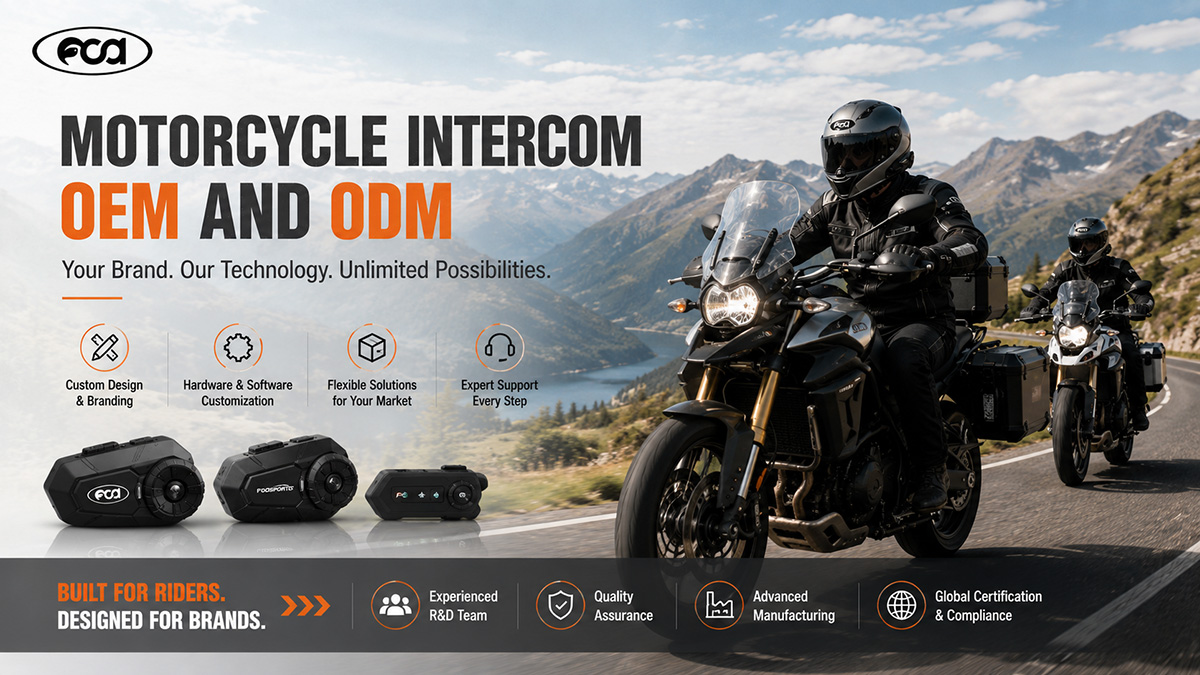
Motorcycle Intercom OEM and ODM
For motorcycle intercoms, this distinction is particularly important because the product involves hardware, Bluetooth technology, speakers, microphones, batteries, firmware, acoustic tuning, and sometimes advanced communication technologies. Choosing the right manufacturing model can affect development cost, time to market, product differentiation, and long-term brand value.
⚙️ What Is OEM Motorcycle Intercom Manufacturing?
Table of Contents
OEM stands for Original Equipment Manufacturer. In a typical OEM arrangement, the buyer controls the product design and provides the manufacturer with detailed requirements, drawings, specifications, or an existing design that needs to be manufactured. The factory's main responsibility is to produce the motorcycle intercom according to those requirements.
For example, a motorcycle accessories company may already have a specific intercom design, button layout, housing structure, speaker specifications, battery requirements, or communication features. The manufacturer then develops the production process and manufactures the product according to the agreed specifications.
OEM manufacturing provides a high level of control. If your company has developed a unique motorcycle communication system or has invested heavily in product research and development, OEM manufacturing can help you maintain greater control over the final product.
When OEM Is a Good Choice
OEM is generally more suitable for established brands or businesses that already know exactly what they want to develop. It can be particularly attractive when product differentiation is important and the company wants its motorcycle intercom to have unique hardware, appearance, functions, or technical specifications.
However, greater customization usually means more engineering work, testing, tooling, and upfront investment. The buyer also needs to be prepared to participate in product development and make decisions throughout the manufacturing process.
🔧 What Is ODM Motorcycle Intercom Manufacturing?
ODM stands for Original Design Manufacturer. In an ODM model, the manufacturer already has an existing product design, technology platform, engineering capability, or product architecture. The buyer selects a suitable base product and then works with the manufacturer to customize elements such as branding, packaging, colors, components, software settings, or selected features.
For example, a supplier may already have a mature Bluetooth motorcycle intercom platform. Instead of developing a completely new product from zero, a distributor can select that platform and customize the logo, packaging, product appearance, accessories, or certain functions for its own market.
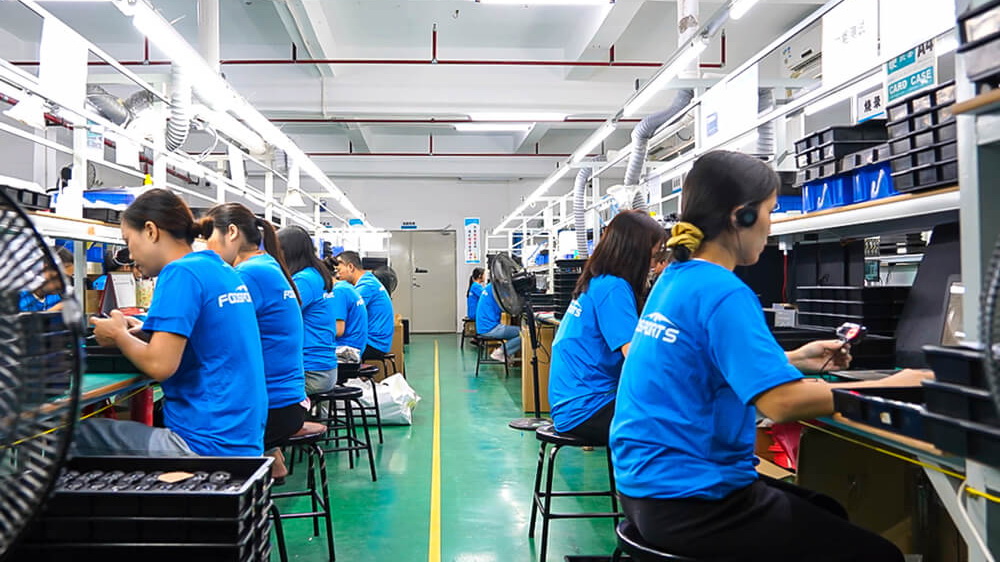
fodsports factory
This approach can significantly reduce development time and initial investment because the underlying product has already been developed and tested.
When ODM Is a Good Choice
ODM is often attractive to startups, distributors, retailers, and companies entering the motorcycle communication market for the first time. If your main strengths are marketing, sales, distribution, or customer service rather than hardware development, using an existing manufacturer platform can allow you to launch products much faster.
The trade-off is that your product may not be completely unique. The underlying design may belong to the manufacturer and, depending on the agreement, similar products may potentially be offered to other customers. Buyers should therefore clarify exclusivity and intellectual property terms before placing a large order.
🔍 OEM vs ODM Motorcycle Intercom: Key Differences
The easiest way to understand the difference is to look at who controls the starting point of the product.
| Factor | OEM | ODM |
|---|---|---|
| Product design | Mainly buyer-controlled | Mainly manufacturer-controlled |
| Customization | High | Low to moderate, depending on supplier |
| Development | New or buyer-specific development | Based on existing platform |
| Initial investment | Usually higher | Usually lower |
| Time to market | Usually longer | Usually faster |
| Design IP | Usually buyer-controlled | Usually manufacturer-controlled |
| Product differentiation | High | Moderate |
| Best suited for | Established brands and unique products | Startups, distributors and market testing |
These are general industry distinctions rather than universal legal definitions. A supplier may use the terms differently, so the actual contract and project scope matter more than the label itself.
💰 Cost, MOQ and Development Time
One of the biggest reasons businesses choose ODM is the lower initial development cost. With an existing product platform, the manufacturer has already invested in engineering, molds, testing, and product development. The buyer therefore does not necessarily need to pay for an entirely new product from scratch.
OEM development usually requires more resources because new tooling, engineering work, prototypes, testing, and design changes may be necessary. Development can take considerably longer than adapting an existing ODM product. Industry sourcing guides commonly describe ODM as having a shorter path to market, while OEM projects require more development work.
MOQ can also differ, although there is no universal MOQ for either model. A supplier may accept a smaller ODM order because the same platform can be produced for multiple customers, while a highly customized OEM project may require a larger order to justify tooling and engineering costs.
For this reason, buyers should not compare suppliers only by unit price. The more useful calculation includes development fees, tooling, testing, packaging, certification, MOQ, shipping, and future production costs.
🎨 Customization and Product Development
Customization is another major difference between OEM and ODM.
With OEM manufacturing, a buyer can have much greater influence over the product's physical design and technical specifications. This may include the housing, button structure, microphone configuration, speaker performance, battery capacity, charging system, firmware behavior, and other functions.
ODM customization is usually based on what the manufacturer's existing platform can support. A buyer may be able to change the logo, packaging, colors, accessories, or selected components without redesigning the entire product.
For motorcycle intercoms, however, customization can go deeper than appearance. Some manufacturers with strong R&D capabilities can provide ODM services covering hardware, firmware, Bluetooth functions, audio algorithms, and communication technologies. Therefore, buyers should ask exactly how much engineering customization the supplier can provide instead of assuming that every ODM supplier only offers logo printing.
🔐 Intellectual Property, Firmware and Tooling
Intellectual property is one of the most important issues when sourcing a motorcycle intercom.
With a traditional OEM project, the buyer generally controls the product design and related intellectual property. With ODM, the manufacturer typically owns the underlying product design, while the buyer owns its branding and any specifically negotiated customization rights.
For electronic products, buyers should also ask about firmware ownership and access. An intercom is not simply a plastic housing and circuit board. Firmware controls important functions such as Bluetooth connections, audio processing, pairing behavior, battery management, and communication features.
Tooling ownership is equally important. If you pay for a custom mold, make sure the agreement clearly states who owns the mold, who can use it, and what happens if you change suppliers.
If exclusivity is important to your business, do not rely on a verbal promise. Define the territory, product version, duration, and conditions of exclusivity in writing.
🏪 Which Model Is Better for Your Business?
There is no universally better choice between OEM and ODM. The right model depends on your business goals.
If you are building a long-term motorcycle intercom brand and want a highly differentiated product, OEM may be the better direction. It provides greater control over product development and can create stronger competitive advantages when your design or technology is genuinely unique.
If you are a distributor, retailer, startup, or importer that wants to test demand quickly, ODM can be more practical. You can use an existing and potentially proven product platform, focus your resources on branding and sales, and enter the market without taking on the full cost of product development.
Some companies also use both approaches over time. They may start with ODM to test a market and understand customer demand, then develop a more customized OEM product after sales volume becomes large enough to justify the investment.
🤝 How to Choose a Reliable OEM or ODM Supplier
Choosing a supplier is just as important as choosing between OEM and ODM.
For a motorcycle intercom project, look beyond a supplier's product catalog. Ask about its R&D team, Bluetooth technology experience, firmware capabilities, acoustic testing, battery quality control, waterproof testing, certification support, production capacity, and after-sales service.
A supplier with genuine motorcycle communication experience will also understand problems that are specific to riders, such as wind noise, microphone placement, helmet compatibility, speaker positioning, connection stability, and long-distance communication.
Most importantly, request samples before committing to a large order. Test the actual product in the environments where your customers will use it, including city riding, highway speeds, group riding, phone calls, and long-distance trips.
📋 Questions to Ask Before Placing an OEM or ODM Order
Before signing an agreement, clearly ask who owns the product design, molds, firmware, and customized components. Confirm exactly which parts can be modified, whether the supplier can provide exclusive versions, what the MOQ is, how long development and production will take, and what happens if the product needs a future firmware or hardware update.
You should also confirm product testing, certification requirements, warranty responsibility, replacement policies, packaging specifications, quality standards, and inspection procedures. These details can prevent major problems after production begins.
❓ FAQs About Motorcycle Intercom OEM and ODM
What is the main difference between OEM and ODM?
The main difference is who controls the product design. OEM generally means the buyer provides or controls the product design and specifications, while ODM generally means the manufacturer provides an existing design or product platform that the buyer can customize.
Is ODM cheaper than OEM?
ODM is often cheaper initially because the manufacturer has already invested in product development and tooling. However, the final cost depends on customization, MOQ, components, packaging, licensing, and production volume.
Can I customize an ODM motorcycle intercom?
Yes. The available customization depends on the manufacturer. Common options include branding, packaging, colors, accessories, and selected hardware or software changes. More advanced suppliers may also support deeper firmware and hardware customization.
Who owns the design in an ODM project?
In a typical ODM arrangement, the manufacturer owns the underlying design while the buyer owns its brand and separately negotiated customization rights. However, ownership can vary by contract, so it should always be clearly defined in writing.
Which is better for a new motorcycle intercom brand?
For a new brand that wants to enter the market quickly, ODM is often the easier starting point. For a company seeking a unique long-term product with greater control over design and intellectual property, OEM may be more suitable.
The difference between motorcycle intercom OEM and ODM is ultimately about who develops the product, who controls the design, how much customization is possible, and who carries the development investment and risk.
OEM provides greater control and stronger opportunities for product differentiation, but it normally requires more development work and investment. ODM offers a faster and potentially lower-risk route to market by using an existing manufacturer platform.
For motorcycle intercom distributors and brands, the best approach is to first define your target market, expected sales volume, required customization, budget, and long-term product strategy. Then choose a supplier whose capabilities, quality standards, intellectual property terms, and production model match those goals.
The most important lesson is simple: do not choose a supplier based only on whether it calls itself an OEM or ODM manufacturer. Understand exactly what the supplier will design, manufacture, customize, own, and support before you place your order.
