

A motorcycle Bluetooth intercom is a wireless communication system designed to let riders talk without removing their hands from the handlebars or stopping the motorcycle. A typical motorcycle helmet intercom contains a microphone, speakers, a wireless communication chip, processor, battery, and control buttons.
Unlike a traditional headset, a motorcycle intercom is designed specifically for a noisy and moving environment. It needs to capture the rider's voice through wind and engine noise, transmit the audio wirelessly, and reproduce another rider's voice through speakers installed inside the helmet.
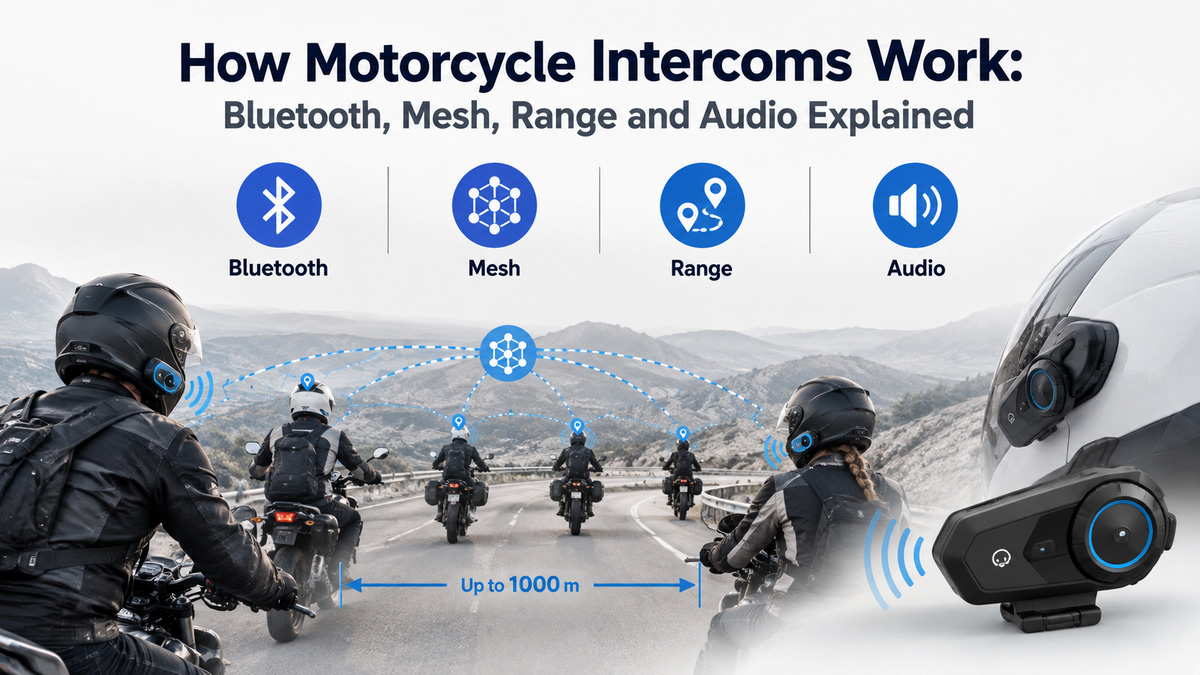
How Motorcycle Intercoms Work: Bluetooth, Mesh, Range and Audio Explained
Modern systems can also connect to smartphones and GPS devices for phone calls, music, navigation instructions, and other audio functions.
🔧 What Components Are Inside a Motorcycle Intercom?
Table of Contents
Microphone and Speakers
The microphone is positioned close to the rider's mouth and captures speech. Depending on the helmet design, riders may use a boom microphone for open-face or modular helmets or a wired microphone for full-face helmets.
Small stereo speakers are installed near the rider's ears. They reproduce voices, music, GPS instructions, and phone calls without requiring earbuds.
Bluetooth Chip and Processor
The wireless chip handles communication between the helmet intercom and other Bluetooth devices. Bluetooth operates in the unlicensed 2.4 GHz ISM band and uses frequency-hopping techniques to reduce the effects of interference.
A processor also manages audio processing, connection control, volume, noise reduction, and other functions. Some advanced motorcycle intercoms use multiple chips so communication and other Bluetooth audio tasks can be handled more efficiently.
Battery and Control System
A rechargeable battery powers the wireless radio, processor, microphone, and speakers. Physical buttons or voice commands allow riders to answer calls, change volume, activate intercom communication, or control music without reaching for a phone.
📡 How Does a Motorcycle Bluetooth Intercom Work?
The basic process is surprisingly simple:
Your voice → microphone → audio processing → wireless transmission → receiving intercom → speakers → other rider's ears
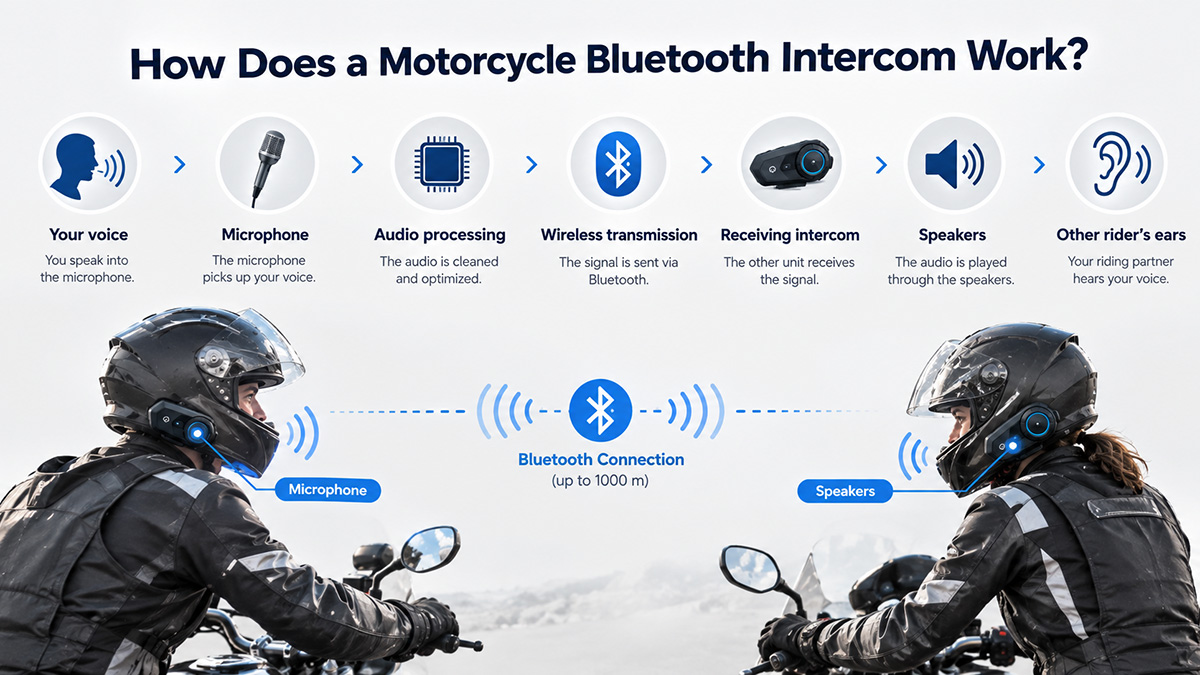
How Does a Motorcycle Bluetooth Intercom Work
Step One: Your Voice Is Captured
When you speak, the microphone converts your voice into an electrical audio signal. However, the microphone also picks up wind, engine, road, and surrounding traffic noise.
This is one of the biggest challenges for a Bluetooth motorcycle intercom because the microphone has to distinguish speech from continuous background noise.
Step Two: Noise Is Reduced and Audio Is Processed
The intercom processes the microphone signal before transmitting it. Depending on the product, technologies such as CVC, ENC, DSP, or microphone noise reduction can be used to reduce unwanted sound.
The goal is not simply to make everything quieter. The system needs to preserve speech while reducing wind and mechanical noise so the receiving rider can understand the conversation.
Step Three: Voice Becomes Digital Data
The processed audio is converted into digital information and prepared for wireless transmission. The Bluetooth system divides information into data packets and sends them through the radio connection.
Bluetooth's adaptive frequency hopping helps reduce the probability of interference by changing communication channels across the 2.4 GHz band.
Step Four: The Other Intercom Receives the Signal
The receiving motorcycle intercom captures the wireless data, processes and decodes it, and converts it back into an audio signal.
The speakers then reproduce the signal inside the other rider's helmet. Because this happens continuously and very quickly, riders can have a normal real-time conversation while moving.
🔗 Bluetooth Intercom vs. Mesh Intercom
Not every motorcycle communication system works in exactly the same way.
Traditional Bluetooth Intercom
Traditional Bluetooth intercom communication is particularly useful for a rider and passenger or two riders traveling together. Some systems can support larger groups through different connection methods, but the connection structure can become more complicated as more riders are added.
This makes a standard Bluetooth helmet intercom a practical choice for riders who usually travel with one partner or a small group.
The Fodsports M1S Pro is an example of a Bluetooth-based motorcycle communication system. It uses Bluetooth 5.0 and supports group communication for up to 10 riders. Fodsports specifies a maximum group intercom distance of up to 2,000 meters under suitable conditions, while the effective distance between two motorcycles can be around 500 meters depending on the environment.
Mesh Intercom
Mesh communication uses a different network structure. Instead of depending on one fixed connection path, participating intercoms can act as network nodes.
If a rider leaves the group or temporarily moves out of range, the remaining riders can continue communicating rather than necessarily losing the entire group connection.
This is especially useful for large group rides where riders naturally spread out.
The Fodsports FX7 Mesh Intercom uses a multi-rider mesh network and supports 2–10 riders. It also uses a dual-Bluetooth-chip design, with separate processing for Bluetooth audio and intercom functions. The FX7 supports Bluetooth 5.4, music/GPS audio while intercom communication is active, and multiple pairing modes.
📱 How Does a Motorcycle Intercom Connect to a Phone or GPS?
A motorcycle Bluetooth intercom can also function as a wireless audio hub.
After pairing the intercom with a smartphone, riders can listen to music, hear turn-by-turn GPS navigation, make phone calls, and use supported voice-control functions.
For example, a rider may listen to navigation instructions through the helmet speakers while keeping the phone stored in a pocket or mounted securely on the motorcycle.
More advanced systems can manage multiple audio sources. The FX7, for example, supports simultaneous intercom communication with music or GPS audio, making it possible to keep navigation information available while communicating with other riders.
📶 What Affects Motorcycle Intercom Range and Sound Quality?
Distance Is Not the Only Factor
An advertised motorcycle intercom range should not be treated as a guaranteed distance in every riding situation.
Open terrain, hills, buildings, trees, traffic, rider position, antenna design, interference, and the orientation of the motorcycles can all affect wireless communication.
For this reason, a product advertised with a maximum range should normally be understood as a measurement obtained under specified or favorable conditions rather than a guaranteed real-world result.
Wind Noise Matters
Even a powerful wireless connection cannot solve poor microphone placement. A microphone exposed directly to high-speed airflow can produce significant wind noise.
Correct microphone positioning, a properly fitted helmet, effective noise reduction, and suitable speaker placement all contribute to better communication quality.
Helmet Fit Also Matters
Speakers should be positioned close to the ears without causing discomfort. A microphone should sit close enough to the mouth to capture speech clearly but should not interfere with helmet operation.
A good installation can make a noticeable difference to the performance of a motorcycle helmet communication system.
🛣️ FX7 Mesh Intercom vs. M1S Pro for Different Riders
The Fodsports FX7 is particularly suitable for riders who frequently participate in group rides and want mesh communication, multi-task audio, and flexible group connectivity. Its mesh network supports up to 10 riders, while its dual-chip architecture separates Bluetooth audio and intercom processing.
The Fodsports M1S Pro is a practical option for riders who want a conventional Bluetooth motorcycle intercom with long-range group communication. Its specifications include Bluetooth 5.0, support for up to 10 riders, CVC noise reduction, 40 mm speakers, and a 2,000-meter maximum group communication distance under suitable conditions.
The better choice depends on the riding style. Riders who regularly organize larger groups and want the flexibility of mesh technology may prefer the FX7, while riders looking for a straightforward Bluetooth-based group communication system may find the M1S Pro more suitable.
🛡️ How to Use a Motorcycle Intercom Safely
A motorcycle intercom should improve communication without becoming a source of distraction.
Before riding, complete pairing, set the volume, configure navigation, and test the microphone. Avoid repeatedly adjusting the device while moving.
Most importantly, communication technology does not replace attention to traffic. NHTSA advises motorcyclists to avoid distractions and keep their focus on the road. The Motorcycle Safety Foundation similarly emphasizes staying visible, maintaining awareness, and riding predictably.
A well-installed motorcycle Bluetooth intercom should allow riders to communicate through simple controls or voice functions while keeping their eyes on the road and hands where they belong.
❓ FAQs About Motorcycle Bluetooth Intercoms
Does a motorcycle Bluetooth intercom need a mobile network?
No. Rider-to-rider intercom communication normally uses a short-range wireless connection between the intercom units and does not require cellular service. A phone connection may be required for functions such as online navigation or phone calls.
Can two different brands of motorcycle intercoms connect?
It depends on the products and their pairing functions. Some motorcycle intercoms support universal or third-party pairing, but compatibility and available functions can vary.
Is Mesh better than Bluetooth for motorcycle communication?
Neither technology is universally better. Traditional Bluetooth can be convenient for two riders or small groups, while mesh technology is particularly useful for larger group rides where riders may spread out or leave and rejoin the group.
Why is my motorcycle intercom range shorter than advertised?
Advertised range is usually measured under favorable conditions. Buildings, hills, trees, traffic, road curves, rider position, interference, and other obstacles can reduce real-world range.
Can I listen to music while using a motorcycle intercom?
Some models support simultaneous music and intercom audio. The exact behavior depends on the intercom's audio architecture. Models such as the Fodsports FX7 support music or GPS audio while intercom communication is active.
