

For a motorcycle communication business, choosing between Mesh Intercom and Bluetooth Intercom is not simply a technical decision. It affects product positioning, target customers, retail price, inventory planning, compatibility, and after-sales support.
A Bluetooth intercom can be an efficient solution for two riders or small groups that want affordable and straightforward communication. A motorcycle Mesh intercom is designed around a more flexible network, making it attractive to touring groups, motorcycle clubs, adventure riders, and customers who regularly ride with changing group formations.
The key takeaway for B2B buyers is simple: neither technology is universally better. The right technology depends on the customer segment, riding scenario, expected group size, price point, and ecosystem compatibility.
🔵 What Is a Traditional Bluetooth Intercom?
Table of Contents
How Bluetooth Intercom Communication Works
Traditional motorcycle Bluetooth communication generally establishes direct connections between intercom units. In a multi-rider configuration, devices may form a connection chain.
For example, Rider A connects with Rider B, Rider B connects with Rider C, and so on. If a rider in the middle moves out of range, the communication path can be interrupted.
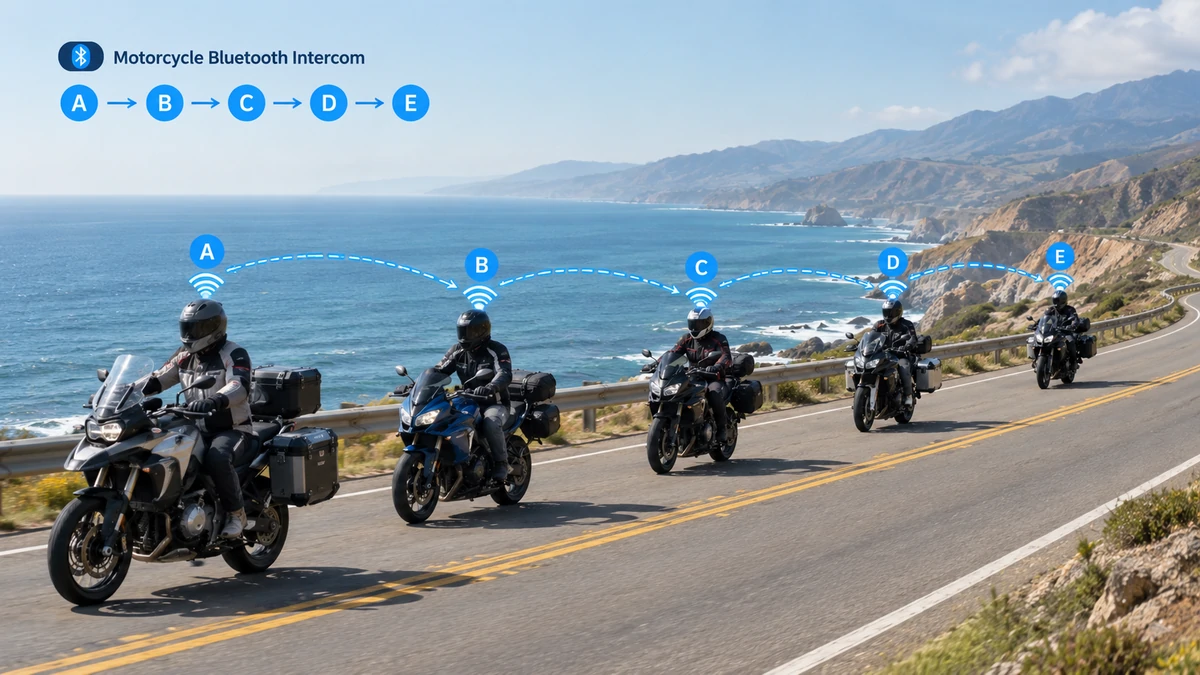
Motorcycle Bluetooth Intercom
Fodsports describes this traditional Bluetooth structure as a chain and notes that a connection may need to be re-established when a rider leaves the communication range.
Bluetooth remains valuable because it is familiar, widely supported, and relatively straightforward. A motorcycle intercom can also use Bluetooth to connect with smartphones and GPS devices for music, navigation instructions, and phone calls.
Why Bluetooth Still Matters in the B2B Market
For brands and distributors, Bluetooth products can serve customers who do not need advanced group networking.
Typical customers include commuters, couples riding together, passengers, two-rider touring groups, and budget-conscious motorcycle riders. These customers may prioritize affordability, simple operation, battery life, and smartphone compatibility over advanced group communication.
That makes Bluetooth motorcycle intercom products an important entry-level or value-oriented category rather than an outdated technology.
🕸️ What Is a Motorcycle Mesh Intercom?
A Network Instead of a Simple Chain
A motorcycle Mesh intercom uses a dynamic network structure. Instead of depending entirely on a fixed communication chain, participating devices can communicate through the mesh network.
This becomes particularly useful when riders change positions. A rider can move farther away, another rider can fall behind, or the group can temporarily separate without necessarily requiring everyone to manually reconnect.
Fodsports's Mesh Intercom documentation describes the technology as allowing riders to join and communicate without individually pairing every headset, with automatic reconnection when riders return to range.
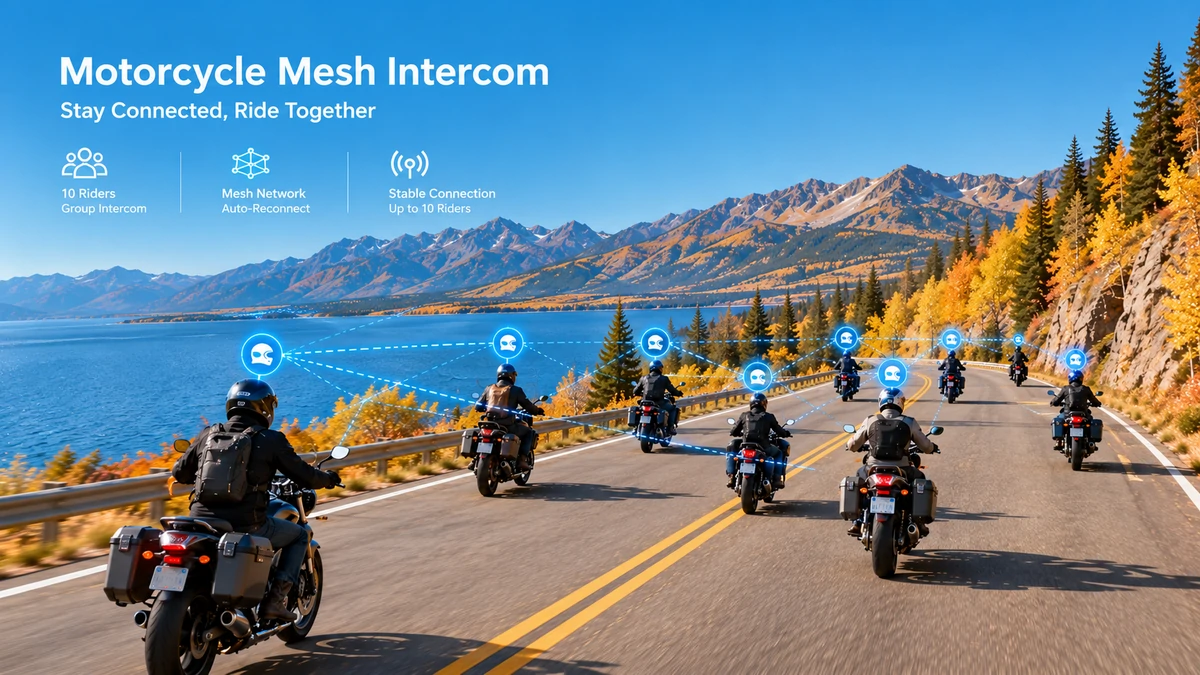
Motorcycle Mesh Intercom
The broader Bluetooth Mesh standard also demonstrates the underlying networking concept: multiple devices can participate in many-to-many communication, and network traffic can continue when individual relay nodes fail. However, motorcycle communication products often use proprietary implementations rather than simply being generic Bluetooth Mesh devices.
Why Mesh Is Attractive for Group Riding
The main commercial advantage of Mesh is not simply a larger advertised range. It is the ability to manage a changing group more naturally.
For motorcycle clubs, guided tours, adventure groups, and organized rides, riders do not always maintain a perfect formation. Mesh technology is designed around this reality.
Some current motorcycle Mesh systems support private groups of up to 24 participants, while open Mesh modes can support substantially larger numbers depending on the manufacturer's implementation.
⚖️ Mesh Intercom vs Bluetooth Intercom: Key Differences
| Feature | Bluetooth Intercom | Mesh Intercom |
|---|---|---|
| Connection | Direct/chain-based | Dynamic network |
| Best use | Two riders and small groups | Group and touring rides |
| Group flexibility | More limited | Higher |
| Reconnection | May require intervention | Generally automatic |
| Setup | Usually simple | More advanced technology |
| Cost positioning | Lower to mid-range | Mid-range to premium |
| Ecosystem concerns | Bluetooth compatibility is broad | Mesh may be proprietary |
| B2B target | Value and everyday riders | Group, touring and premium riders |
One important point for B2B buyers is that Mesh should not automatically be marketed as having better range. Real-world range depends on terrain, obstacles, rider spacing, antenna design, interference, and product implementation.
For example, Fodsports publishes up to 2 km of open-terrain range for some Bluetooth and Mesh modes, while its Mesh documentation explains how multiple riders can extend overall communication coverage.
This illustrates why distributors should compare the complete communication architecture rather than simply comparing the largest number printed on a product page.
👥 Which Technology Fits Different Customer Groups?
Bluetooth for Value-Oriented Customers
Bluetooth is particularly suitable when the customer's communication needs are predictable.
A retailer serving commuters and casual riders may find that an affordable Bluetooth intercom is easier to explain and sell. The customer can pair the device with a phone, GPS, or another intercom without needing to understand a more complicated network system.
For B2B businesses, this creates an opportunity for a strong entry-level product category with a clear value proposition.
Mesh for Clubs, Touring and Adventure Riders
Mesh becomes more attractive when customers regularly ride in larger or changing groups.
Touring companies, motorcycle clubs, adventure riders, riding schools, and organized motorcycle events may place greater value on automatic reconnection and group communication than on the lowest possible purchase price.
For these customers, a Mesh motorcycle intercom can be positioned as a productivity and convenience tool rather than simply another helmet accessory.
💰 B2B Cost, Product Positioning and Inventory Considerations
Do Not Build Your Product Line Around Technology Alone
For a distributor or retailer, the most practical strategy is often to create different product levels rather than choosing only one technology.
An entry-level Bluetooth product can target price-sensitive customers. A higher-level Mesh product can target group riders and touring customers. This creates a clearer product ladder and reduces the risk of forcing every customer into an expensive communication system.
Since 2014, Fodsports has focused on motorcycle Bluetooth communication technology and has developed experience across product development, manufacturing, quality control, logistics, and after-sales service. From a manufacturer's perspective, this long-term product experience is useful because the commercial value of an intercom depends on more than its wireless protocol: microphone performance, speakers, battery, waterproofing, firmware, mounting hardware, and usability all affect customer satisfaction.
Consider Total Business Cost
B2B buyers should evaluate more than factory price. Important factors include MOQ, development costs, certification requirements, firmware support, replacement accessories, warranty handling, packaging, spare parts, lead times, and compatibility.
A lower purchase price does not necessarily produce a lower total cost if the product creates higher return rates or complicated after-sales problems.
🔧 What B2B Buyers Should Evaluate Before Choosing a Supplier
Test Real Riding Conditions
Do not rely entirely on laboratory specifications or advertised range. Test products with motorcycles in realistic conditions.
A useful test should include open roads, curves, hills, traffic, different rider spacing, and temporary separation between riders. Record not only maximum distance but also reconnection behavior, voice clarity, music performance, battery endurance, and ease of operation.
This is especially important because manufacturers use different testing environments and definitions for range.
Check Compatibility and Ecosystem Strategy
Compatibility can become a major selling issue. Bluetooth connections between different brands may be possible, but advanced Mesh functions are often tied to a manufacturer's own ecosystem.
Fodsports, for example, states that its proprietary Mesh system requires compatible Fodsports Mesh devices, although its products can also provide Bluetooth connections to other brands.
For a B2B buyer, this means supplier selection should include a clear understanding of cross-brand compatibility, universal pairing functions, app support, firmware updates, and future product compatibility.
Evaluate the Complete Product
A reliable Motorcycle Intercom is more than a radio module. Buyers should evaluate microphone noise reduction, speaker quality, battery capacity, waterproofing, buttons, mounting systems, charging ports, firmware stability, mobile-app performance, and technical support.
For the equipment category, terms such as Helmet Communication, Bluetooth Intercom, and Motorcycle Intercom can also help retailers organize their product catalog according to customer search intent.
📈 Market and Technology Trends
Bluetooth remains an enormous wireless technology ecosystem. The Bluetooth SIG's 2024 market update forecasts 7.5 billion Bluetooth-enabled devices shipping annually by 2028, representing an estimated 8% compound annual growth rate over five years. This broader market data does not represent motorcycle intercom sales specifically, but it demonstrates the continuing scale and development of Bluetooth connectivity.
At the motorcycle communication level, manufacturers are also continuing to invest in Mesh. Fodsports's current systems combine Mesh and conventional Bluetooth modes, showing that the two technologies are increasingly being positioned as complementary rather than mutually exclusive.
This is an important signal for B2B companies: the market does not have to be divided into “Bluetooth products” versus “Mesh products.” A stronger product portfolio can use both technologies to cover different customer requirements and price levels.
🏁 How to Build the Right Motorcycle Intercom Product Strategy
For a motorcycle communication brand, distributor, or wholesaler, the best approach is to start with customer use cases rather than technology names.
If your customers mainly ride alone, with a passenger, or in pairs, Bluetooth can provide the essential functions without unnecessary complexity.
If your customers frequently participate in large group rides, motorcycle tours, adventure trips, or organized club events, Mesh becomes much more relevant.
The most useful B2B strategy is therefore not to ask, “Is Mesh better than Bluetooth?” Instead, ask:
Who will buy the product, how many riders will communicate, how often will the group change, what price can the market support, and what ecosystem will customers expect?
For manufacturers and distributors, this approach makes product selection, inventory planning, marketing, and after-sales support much easier—and ultimately creates a more practical motorcycle communication product portfolio.
❓ Frequently Asked Questions
Is Mesh better than Bluetooth for motorcycle intercoms?
Neither technology is universally better. Bluetooth is practical for simple communication and smaller groups, while Mesh is designed to make larger and changing group communication easier.
Is a Mesh motorcycle intercom more expensive?
Generally, Mesh systems are positioned higher than basic Bluetooth intercoms because of their more advanced networking hardware and software. However, pricing varies significantly between manufacturers and product tiers.
Can Bluetooth and Mesh intercoms work together?
It depends on the products. Some systems support universal Bluetooth pairing between different brands, but this usually does not provide the full Mesh functionality of a compatible Mesh ecosystem.
How many riders can connect through a Mesh intercom?
There is no single industry-wide limit. Current systems vary considerably. For example, Fodsports documents private Group Mesh configurations supporting up to 24 participants on certain products.
What should a B2B buyer look for in a motorcycle intercom manufacturer?
Look beyond wholesale price. Evaluate product stability, real-world communication performance, MOQ, certifications, firmware and app support, accessory availability, warranty policy, production capacity, customization options, and long-term after-sales support.
📚 Authoritative Sources
- Bluetooth SIG — 2024 Bluetooth Market Update: https://www.bluetooth.com/2024-market-update/
- Bluetooth SIG — Bluetooth Mesh Networking Primer: https://www.bluetooth.com/bluetooth-mesh-networking-primer/
