

For a motorcycle intercom distributor, wholesaler, retailer, or private-label brand, certification is much more than a logo on a product page. It can determine whether a wireless communication device can legally enter a target market, pass customs and market surveillance checks, and be sold without creating unnecessary compliance risks.
The three terms most often discussed are CE, FCC, and RoHS. However, they serve different purposes. CE is an EU conformity framework covering applicable product requirements, FCC concerns radio-frequency and electromagnetic compliance in the United States, while RoHS focuses on restricted hazardous substances in electrical and electronic equipment.
For B2B buyers, the practical lesson is simple: do not ask only whether a motorcycle intercom is “certified.” Ask which market it is certified or declared compliant for, which standards were tested, which exact model and hardware configuration were evaluated, and whether the supplier can provide supporting documentation.
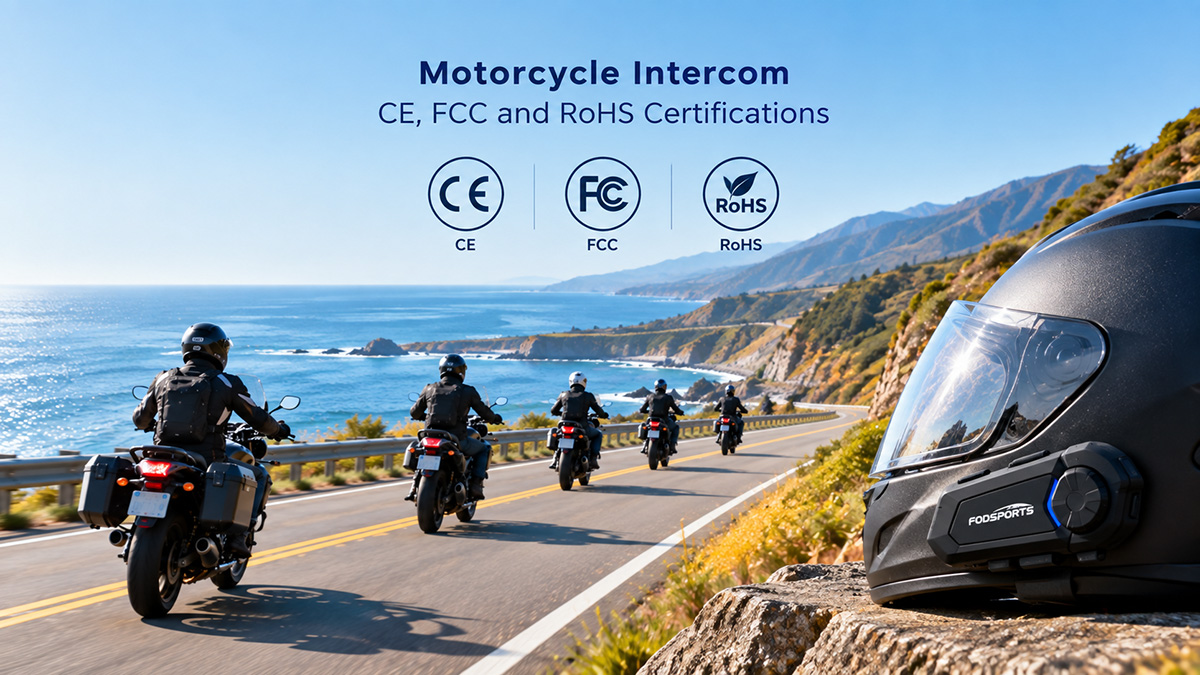
Motorcycle Intercom CE, FCC and RoHS Certifications
🌍 CE, FCC and RoHS: What Do They Actually Mean?
Table of Contents
CE: European Market Conformity
CE marking indicates that the manufacturer has declared conformity with applicable EU legislation. It is not a universal safety approval issued by the European Union, and not every product is legally allowed to carry a CE mark. The European Commission specifically states that CE marking is mandatory only for products covered by EU harmonisation rules that require it.
For a Bluetooth motorcycle intercom, the Radio Equipment Directive (RED) 2014/53/EU is particularly important because the product contains radio functionality. The European Commission identifies Bluetooth-equipped products as examples of radio equipment within the scope of RED.
Depending on the product design, compliance work can involve radio spectrum performance, electromagnetic compatibility, electrical safety, and other applicable requirements.
FCC: United States Radio-Frequency Compliance
FCC requirements are relevant when wireless electronic products are marketed or imported in the United States. FCC Part 15 establishes requirements for RF devices, including limits designed to prevent harmful interference.
For intentional radiators, such as wireless transmitters, FCC rules can require equipment authorization before the product is marketed or imported. The authorization route depends on the device and applicable rules.
This is especially relevant to a motorcycle intercom because Bluetooth communication involves intentional RF transmission.
RoHS: Restricting Hazardous Substances
RoHS stands for Restriction of Hazardous Substances. Unlike CE and FCC, RoHS is not primarily about wireless performance or electromagnetic emissions. It restricts certain hazardous substances in electrical and electronic equipment.
The EU currently restricts ten substances under the RoHS framework, including lead, mercury, cadmium, hexavalent chromium, PBB, PBDE, and four specified phthalates.
For B2B buyers, RoHS therefore involves the materials and components used throughout the product, rather than simply testing the Bluetooth signal.
📊 CE vs FCC vs RoHS: The Key Differences
| Requirement | Main Market | Main Purpose | Relevant to Motorcycle Intercoms |
|---|---|---|---|
| CE | EU/EEA | Conformity with applicable EU product legislation | Yes |
| FCC | United States | RF and electromagnetic compliance | Yes |
| RoHS | EU/EEA and supply chains globally | Restriction of hazardous substances | Yes |
| Main focus | Product conformity | Radio/electromagnetic emissions | Materials and substances |
| Typical buyer concern | Legal market access | U.S. wireless compliance | Environmental/material compliance |
The important point is that CE, FCC, and RoHS are complementary rather than interchangeable. A product having one does not automatically mean it satisfies the requirements represented by the others.
📋 What Documents Should a B2B Buyer Request?
Do Not Stop at a Certificate Logo
One common sourcing mistake is accepting a supplier's website screenshot showing CE, FCC, or RoHS without checking the underlying documents.
For CE-related products, buyers should request the EU Declaration of Conformity, applicable test reports, product identification information, and technical documentation where appropriate. EU guidance also emphasizes that manufacturers and economic operators need to be able to demonstrate conformity to market surveillance authorities.
For FCC, buyers should verify the applicable equipment authorization information and whether the tested configuration matches the product being purchased. The FCC maintains an Equipment Authorization System and related databases for authorized RF devices.
For RoHS, buyers should request relevant test reports or supplier declarations that identify the product and demonstrate compliance with the applicable substance restrictions.
Check the Exact Model and Hardware Version
This is particularly important for OEM and ODM motorcycle intercoms.
Suppose a supplier has already tested one version of a Bluetooth intercom but later changes the Bluetooth chipset, antenna, PCB, battery, charging circuit, or enclosure. The original test documentation may no longer represent the final product configuration.
The FCC also provides specific guidance for transmitter modules and host products, illustrating why simply using a pre-certified wireless module does not automatically eliminate all compliance considerations for the finished product.
For B2B purchasing, always match:
Model → PCB → wireless module → antenna → firmware → battery → charger → final enclosure → test report.
🔬 What Testing Is Relevant to a Motorcycle Intercom?
A modern Motorcycle Intercom is more than a simple Bluetooth headset. It can contain Bluetooth radio hardware, microphones, speakers, batteries, charging circuits, digital processors, buttons, LEDs, and sometimes cameras, GPS, Mesh communication, or mobile-app connectivity.
This means buyers should look at the complete compliance package rather than focusing only on Bluetooth.
Typical evaluation areas can include:
RF and Wireless Performance
The wireless section needs to operate within applicable frequency, power, bandwidth, and unwanted-emission requirements. FCC Part 15, for example, contains requirements for intentional and unintentional RF devices.
EMC and Electrical Safety
The finished product should also be evaluated for electromagnetic compatibility and relevant electrical safety requirements applicable to its market.
For an everyday rider, these tests are invisible. From a B2B perspective, however, they help determine whether a product can be responsibly placed on the market.
Materials and Components
RoHS compliance requires attention to materials used in PCBs, solder, cables, plastics, connectors, and other components.
This is why an experienced Helmet Communication manufacturer needs reliable component sourcing and quality control rather than simply purchasing a wireless module and assembling a finished product.
🏪 Why Certification Matters to Distributors and Wholesalers
Certification becomes particularly important when products move through several levels of the supply chain.
A distributor may purchase 500 or 1,000 units from a manufacturer and sell them to multiple retailers. If a compliance problem appears later, the commercial consequences can involve product returns, marketplace restrictions, customs problems, inventory losses, or reputational damage.
EU authorities are increasing attention to imported and online-sold products. In 2025, EU customs authorities recorded 387,588 controls, while small parcels entering the EU reached approximately 5.9 billion. The European Commission also reported that a large-scale 2025 control operation involving 11,338 products found substantial non-compliance in the specific product categories examined.
These figures do not mean motorcycle intercoms have the same non-compliance rate. They demonstrate a broader B2B reality: product compliance and documentation are increasingly important in cross-border e-commerce.
🧩 Certification Considerations for OEM and ODM Projects
For brands developing private-label motorcycle intercoms, certification should be discussed before production begins.
A buyer should confirm who is responsible for testing, whose company name appears on compliance documents, which markets are covered, whether the documentation can support private-label sales, and what happens if the hardware or firmware changes.
It is also important to clarify whether testing covers the complete finished product or only a component.
From a practical product-development perspective, this can prevent a common problem: completing packaging, manuals, and a large production run only to discover that a hardware change requires additional compliance work.
For a Bluetooth Intercom or Mesh communication product, certification planning should therefore be part of product development—not an afterthought before shipment.
🔍 How to Verify a Motorcycle Intercom Supplier
Ask These Questions Before Placing a Bulk Order
A reliable supplier should be able to explain:
- Which markets the product is designed for
- Which applicable standards were tested
- Whether CE documentation includes an EU Declaration of Conformity
- What FCC authorization applies to the U.S. version
- How RoHS compliance is documented
- Which exact model and hardware version were tested
- Whether firmware or component changes trigger retesting
- Who is responsible for maintaining compliance documents
- Whether test reports can be reviewed before mass production
For a B2B buyer, responsiveness to these questions can be just as informative as the product specification sheet.
🛠️ Certification Is Only One Part of Supplier Quality
Certification should never be the only supplier-selection criterion.
When evaluating motorcycle communication equipment, buyers should also test microphone clarity, speaker performance, battery endurance, waterproofing, mounting reliability, intercom range, reconnection behavior, app stability, firmware updates, accessories, packaging, warranty support, and production consistency.
From a rider's perspective, these details become obvious during real-world use. On a long motorcycle trip, for example, a technically compliant device is still disappointing if the microphone picks up excessive wind noise, the battery cannot last through the riding day, or the mounting system becomes loose.
This is why B2B buyers should combine laboratory compliance evidence with real riding tests before committing to large inventory quantities.
📈 Why Compliance Documentation Is Becoming More Important
The European Commission describes market surveillance as a mechanism for identifying non-compliant products and allowing authorities to take actions such as recalls, withdrawals, or sanctions.
At the same time, EU rules increasingly place responsibilities on manufacturers, importers, distributors, and other economic operators.
For B2B companies, this means certification documents should be treated as part of the product's commercial assets. A good supplier should maintain organized records that can be quickly provided when a marketplace, customs authority, distributor, or business customer requests proof of compliance.
In other words, a certification logo helps marketing, but complete documentation supports the business.
🏁 Final Takeaway for B2B Motorcycle Intercom Buyers
CE, FCC, and RoHS represent different compliance requirements, and understanding their differences can help distributors, wholesalers, retailers, and private-label brands make better sourcing decisions.
CE is mainly about conformity with applicable EU product legislation, FCC focuses on U.S. radio-frequency and electromagnetic requirements, and RoHS addresses restricted hazardous substances in electrical and electronic equipment.
The safest B2B approach is not simply to ask, “Does this motorcycle intercom have CE, FCC, and RoHS?”
Instead, ask:
What market does the documentation cover? What exact product was tested? Which standards were applied? Can the supplier provide the supporting reports and declarations? And will the documentation remain valid if the hardware or firmware changes?
That level of verification can reduce compliance surprises and help build a more reliable long-term motorcycle communication product portfolio.
❓ Frequently Asked Questions
Is CE certification required for motorcycle intercoms in Europe?
Wireless motorcycle intercoms generally fall within the scope of EU radio equipment rules, including the Radio Equipment Directive, when placed on the EU market. The exact conformity assessment depends on the product and applicable legislation.
Is FCC certification required for Bluetooth motorcycle intercoms in the United States?
Wireless products operating as intentional RF transmitters can be subject to FCC equipment authorization requirements. The exact authorization procedure depends on the device and applicable FCC rules.
Is RoHS the same as CE?
No. RoHS restricts specified hazardous substances in electrical and electronic equipment. CE marking indicates conformity with applicable EU legislation and may encompass multiple requirements, including RoHS where applicable.
Should B2B buyers ask for test reports?
Yes. Test reports, declarations, authorization information, and product identification records can provide much more useful evidence than simply seeing a CE, FCC, or RoHS logo on a product page.
Can changing the Bluetooth chip affect certification?
Yes, potentially. Changing a wireless module, antenna, PCB, firmware, or other significant hardware elements can affect the compliance assessment. B2B buyers should confirm with the manufacturer and relevant compliance experts before treating an existing report as applicable to a modified product.
📚 Authoritative Sources
- European Commission — CE Marking: https://single-market-economy.ec.europa.eu/single-market/goods/ce-marking_en
- European Commission — RoHS Directive: https://environment.ec.europa.eu/topics/waste-and-recycling/rohs-directive_en
- U.S. Federal Communications Commission — Equipment Authorization: https://opendata.fcc.gov/Engineering-Technology/EAS-Equipment-Authorization-Grantee-Registrations/3b3k-34jp
- European Commission — E-commerce Product Compliance and Safety: https://taxation-customs.ec.europa.eu/customs/eu-customs-union-facts-and-figures/e-commerce-product-compliance-and-safety_en
